Reactor Modelling: ANN, LSTM & CNN
Three neural networks against three simple baselines, on three lab recordings.
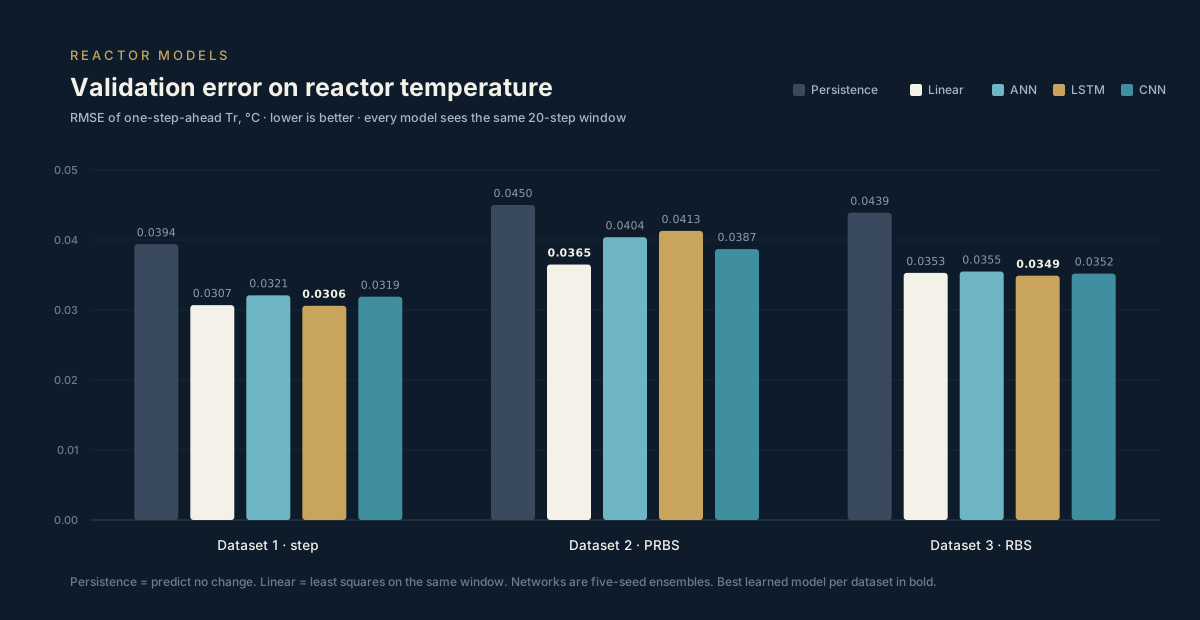
Just predicting "no change" already scores R² above 0.98, because the reactor heats slowly compared with the 0.5 s sampling. So a high R² says almost nothing here, and every model had to beat that baseline instead.
Problem
Predict the reactor and jacket temperature one step ahead from the inputs applied to a real lab reactor, and find out whether a neural network actually helps.
System
Three recordings of the same rig, each driven differently: a step test, a multi-level PRBS and an RBS. Every model sees the same 20-step window of 12 features: the raw inputs, the temperature differences that drive heat flow, and the recent trend. The models predict the change in temperature rather than the temperature itself, so they never have to extrapolate past what they trained on. Validation is an untouched block from the middle of each run, and each network is averaged over five random seeds.
My part
I led a team of six and did most of the work myself: the data pipeline, the feature design, all three networks, the baselines and ARX fits, and the write-up.
Result
No network was consistently best. The linear model won on one dataset, the LSTM edged ahead on the other two, and the gap to the linear fit was never more than about 0.002 °C. A three-lag ARX equation came close while staying readable term by term. Its reactor-temperature coefficients add up to about 1, which says the temperature mostly follows its own recent history.